Importing a car from the UK to Spain after Brexit
In short
Since Brexit, a car brought from the UK to Spain is a customs import from a third country: unless you qualify for transfer of residence relief, expect 10% customs duty (0% only with proof of UK preferential origin) plus 21% import VAT. You then need proof of EU conformity, a Spanish ITV inspection, registration tax based on CO2 emissions and DGT registration on Spanish plates. Residents cannot keep driving on British plates, so plan the import before the car arrives.
Importing a car from the UK to Spain has been a different job since 1 January 2021. Great Britain is now a third country for EU customs purposes, so a British car crossing into Spain is an import, with a customs declaration, duty and VAT, rather than a simple re-registration. The good news is that many people moving here qualify for relief, and the steps are predictable once you know them. This guide covers the rules for private individuals bringing a car into mainland Spain or the Balearics.
What changed after Brexit
Before Brexit, a UK car moving to Spain only needed a Spanish ITV inspection, registration tax and DGT registration. Now there is a customs stage first:
- The car must be declared to Spanish customs on a customs declaration (DUA).
- Customs duty and import VAT are due unless a relief applies.
- The DGT will not register the car without proof it has cleared customs.
Northern Ireland has special status for goods, so check your case separately if the car is coming from there.
Before the car leaves the UK
Tell the DVLA you are exporting the car permanently. Fill in the permanent export section of the V5C log book, detach it and send it to the DVLA. Keep the rest of the V5C: you will need it in Spain as proof of the car’s registration.
Gather the purchase invoice or other proof of ownership, the service history and, if you have one, the manufacturer’s Certificate of Conformity (CoC). If you are claiming transfer of residence relief, also keep evidence of how long you lived in the UK and how long you have owned the car.
Customs duty and VAT
When the car is declared at customs, the value used is the transaction price plus the cost of transport and insurance to the EU border. Customs can use other methods, including Hacienda’s published used-car values, if it does not accept the invoice price.
- Customs duty: 10% for cars as a general rule. Under the EU-UK Trade and Cooperation Agreement a car can enter at 0%, but only if it meets the rules of origin and you present valid proof of preferential origin, such as a statement on origin from the exporter. A UK number plate or a UK invoice is not proof of origin, and a car built in the EU that has been used in the UK does not count as UK origin. For most private imports of used cars, plan on 10%.
- Import VAT: 21%, charged on the customs value plus the duty.
Classics. Cars over 30 years old in original condition may be classified as collectors’ items, which changes the tariff treatment. The rules are specific and customs will want evidence, so confirm the classification with a customs agent before shipping.
Transfer of residence relief
If you are moving your home to Spain from the UK, you may be able to import your car free of duty and import VAT. The Agencia Tributaria’s conditions are:
- You lived outside the EU for at least 12 consecutive months before the move.
- The car is yours, second-hand, and you used it at your former home for at least six months before moving.
- It was bought with the normal taxes paid in the country of origin, with no export refund.
- You clear it through customs within 12 months of establishing your normal residence in Spain. Importing before you move is possible if you undertake to move within six months, and customs may ask for a guarantee.
- You do not sell, lend or hire out the car for 12 months after import, and you keep using it for the same purposes as before.
Customs will ask for your padrón registration in your new town, proof of residence outside the EU for the previous 12 months, and a document showing when you became the owner.
Registration tax (Impuesto de Matriculación)
The Impuesto Especial sobre Determinados Medios de Transporte (IEDMT), better known as registration tax, is paid once, before the car is first registered in Spain. For cars it depends on official CO2 emissions:
| Official CO2 emissions | Rate (mainland and Balearics) |
|---|---|
| Up to 120 g/km | 0% |
| Over 120 and under 160 g/km | 4.75% |
| From 160 to under 200 g/km | 9.75% |
| 200 g/km and over | 14.75% |
Communities can set their own rates for the higher bands; Andalucía’s law sets 14.75% for the top band, the same as the state rate. For a used car the tax is charged on its market value, and Hacienda’s annual price tables (the same ones used for transfer tax) are the usual reference.
It is filed on Modelo 576. If you qualify for an exemption, you use Modelo 05 or 06 instead. There is an exemption for people moving their home to Spain, with conditions close to the customs relief: 12 months’ residence abroad, at least six months’ use of the car there, and no sale for 12 months after registration.
Homologation, ITV and the documents
Before registration the car must show it meets EU technical rules and pass a Spanish ITV inspection for imported vehicles.
Proof of conformity, one of:
- CoC (Certificate of Conformity), issued by the manufacturer. Many cars sold new in the UK before Brexit were built to EU type approval, so the manufacturer may be able to issue one. Ask the brand for your exact VIN.
- Ficha técnica reducida, a reduced technical sheet signed by a qualified engineer, accepted as an alternative to the CoC.
- Individual homologation, typically for cars without EU type approval or older cars without the EU approval mark. This can involve an engineer’s report, lab tests and physical changes.
At the ITV station you present the car with the UK registration document, the proof of conformity and the purchase documents. If it passes, the ITV issues a Spanish ficha técnica.
Taxes and registration. With the customs paperwork (including the import certificate the DGT asks for), the ficha técnica and proof of registration tax, you pay the municipal road tax (IVTM) at the town hall and apply to the DGT for registration. The DGT registration fee is tasa 1.1, which third-party guides list at 99.77 euros for 2026; check the DGT’s fee catalogue before paying. You then buy plates from an authorised maker and insure the car on its Spanish registration.
Typical timescales
There is no official timescale, and it depends mainly on homologation. A car with a CoC and a straightforward customs clearance moves much faster than one needing individual approval or modifications. Plan in weeks, not days, and allow more for a classic or an unusual model. Note that the Agencia Tributaria says residents cannot drive foreign-registered cars and imported vehicles should be registered on arrival; the DGT’s temporary green plates (two months, extendable) cover the gap.
Left-hand drive versus right-hand drive
A right-hand drive car can be registered in Spain if it meets the technical rules. The ITV will check the headlights are suitable for driving on the right, which may mean adjusting or replacing them, along with the rest of the lighting and instruments. The bigger questions are practical:
- Overtaking on two-lane roads is harder and less safe from the wrong side.
- Toll booths, car park barriers and drive-throughs are on the left of the car.
- Resale value in Spain is generally lower, and the pool of buyers is smaller.
- Insurance choices can be narrower.
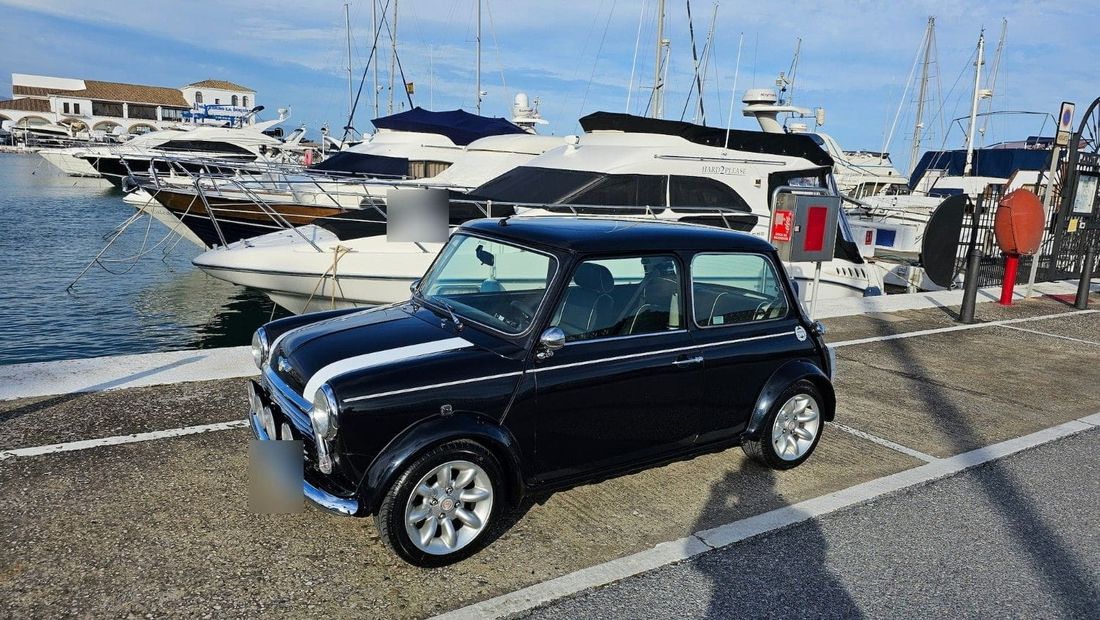
For an everyday car, the sums often favour selling in the UK and buying a left-hand drive car here. For a special car, a rare classic or one with family history, importing can make sense. A classic Mini is a different decision from a five-year-old family hatchback.
How we can help
We look at whether importing actually makes sense for your car, then handle the chain: customs, homologation, ITV, registration tax and Spanish plates, working with trusted local professionals. If buying in Spain is the better route, we can source the left-hand drive equivalent instead. See our car import service, our guide to buying a car in Spain as a foreigner, or contact us.
Sources
- Agencia Tributaria: documentation to import a vehicle
- Agencia Tributaria: leaflet on importing a vehicle from outside the EU (PDF)
- Agencia Tributaria: vehicles on transfer of residence
- Agencia Tributaria: driving a vehicle with foreign number plates
- DGT: importar un vehículo de fuera de la UE
- administracion.gob.es: registration tax when moving a vehicle to Spain
- Ley 38/1992 de Impuestos Especiales, articles 65, 66 and 70 (BOE)
- Ley 5/2021 de Tributos Cedidos de Andalucía, article 57 (BOE)
- GOV.UK: permanently exporting your vehicle